Jul 2, 2009

TeamSeagrass is now certified!

I just got my fabulous Seagrass-Watch certificate for attending the Seagrass-Watch training sessions in May!
The certificate looks so professional! It's probably one of hardest certs that I've had to work for.

Len and Rudi worked even harder than all of us!
They conducted three sessions: Level 1 classroom and Level 1 field and Level 2 classroom. And also audited our processes during our Semakau monitoring in May.
With this massive exercise, all core TeamSeagrass volunteers are certified as well as many of those who have just joined. This gives us confidence in doing our monitoring work effectively, correctly and safely.

Thank you Len and Rudi!

Jun 30, 2009

Seagrass-Watch Issue 37 June 2009 now out!

Len McKenzie has just announced the latest issue of Seagrass-Watch news!
He says: "In this issue two of the worlds leading scientists on seagrass physiology (Mats Björk and Sven Beer) debate the affects of ocean acidification and the role seagrass could play in mitigating the effects. Let’s hope that our high-productivity meadows may be looked upon as areas that are safe from ocean acidification, further highlighting the need for their protection from decline."

Yes, indeed. Our work on our seagrasses can have a broader impact in better understanding and protecting seagrasses everywhere!

And TeamSeagrass is in the news too! There's a great article with lots of sneaky photos of us at the recent Seagrass Workshop in May.
And our Seagrass Angels at Labrador are also in the news!
There's a feature of their study of seagrass growth at Labrador!
(Click on image for a larger view)

There are lots of other articles about seagrass monitoring all over the world. With lovely photos of the seagrasses and amazing animals found there. Like this one taken in Bali by Rudi!
There is also a feature on the estuarine crocodiles with advice on how to be croc wise. I'm not sure whether to be happy or sad that we in Singapore don't have too much to worry about regarding estuarine crocodiles. Sigh.

Well, some of the "croc wise" tips still do apply to us. Like "Never swim or stand in water above knee-height".

So do go to the Seagrass-Watch website and download the PDF of the latest newsletter! Refresh your screen if you don't see the icon for the latest issue.

Destruction of seagrass on a par with loss of rainforests and coral reefs

While the world has focused on the destruction mankind has brought to coral reefs, the massive loss of an equally important ecosystem has been widely ignored.

Now the first comprehensive assessment of the state of seagrass meadows around the world has revealed the damage that human activities have wrought on these economically and biologically essential areas.
Seagrass meadows on Cyrene Reef facing our container terminal.

A synthesis of quantitative data from 215 sites suggests that the world has lost more than a quarter of its meadows in the past 130 years, since records began, and that the rate of that decline has grown from less than 1% per year before 1940 to 7% per year since 1990.

"Seagrass loss rates are comparable to those reported for mangroves, coral reefs and tropical rainforests, and place seagrass meadows among the most threatened ecosystems on earth," write the authors of the synthesis, which is published this week in the Proceedings of the National Academy of Sciences1. "Our report of mounting seagrass losses reveals a major global environmental crisis in coastal ecosystems, for which seagrasses are sentinels of change."

As well as supporting unique wildlife such as green turtles (Chelonia mydas) and dugong (Dugong dugon), seagrass meadows also serve as a vital nursery for fish, supporting populations for coral reefs and commercial fisheries. They also serve to stabilize sediment and provide coastal protection, as well as trapping carbon and helping in nutrient transportation.

Some fishes in the seagrass meadows of Cyrene Reef, being tagged by Collin.

Study author Frederick Short, a researcher at the University of New Hampshire, Durham, admits that there is "not that much data" available on seagrass, so the total loss is difficult to pin down exactly.

[Thus efforts such as TeamSeagrass will contribute towards closing the data gaps.}

The vast majority of this decline, say Short and other experts, is attributable to human activity. Nutrient and sediment pollution from nearby human activities and the introduction of invasive species are both contributing to their decline.

Giuseppe DiCarlo, marine climate change manager at Conservation International and a member of the steering committee of the World Seagrass Association, told Nature News that even where seagrass meadows have been lost there is the opportunity for recovery if protection via the designation of Marine Protected Areas can be brought in.

Full media articles on this study on the wildsingapore news blog.

Jun 26, 2009

Chek Jawa (27 Jun 09)

Bright and early this morning, we're back on Chek Jawa to see how things are growing there.
Chek Jawa sure looks nice in what promises to be a scorching day. The mangroves that ring the seagrass meadows are glowing in the morning sun.
The boardwalk has lots of interpretive panels including one about the seagrass meadows.
The panel is located near what is probably our best growth of Smooth ribbon seagrasses (Cymodocea rotundata). And today, they seem to have grown over a larger area.
They sure look well, even looking down from the tall boardwalk.
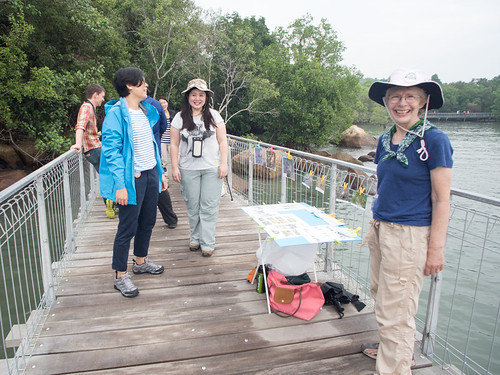
The Team makes its way to the shore via the pontoon which reaches out into the seagrass meadows.
And we've got our spiffy "Seagrass Monitoring in Progress" banner up to tell visitors what we're doing and how they too can join us to make a difference for our shores!
Down a ladder and we're off to monitor. Here's the team starting on their trek to the far off site on the Northern sand bar.While here's the team doing the site nearer the boardwalk.
While they are busy monitoring, I take the opportunity to check out the coral rubble area near the Chek Jawa beacon. Wow, it sure is very grassy!
With lots of Fern seagrasses (Halophilia spinulosa), Needle seagrass (Halodule sp.) and Spoon seagrasses (Halodule ovalis).
The seagrasses are thick all the way from the sand bar near the beacon to the high shore near the boardwalk.
The pools were full of seagrasses!
In some parts though, the Fern seagrasses seem to have lost their leaflets, leaving just the stems.
And along the sandbar, I came across one lonely clump of Tape seagrass (Enhalus acoroides).
Also on the sand bar, in the thick carpet of grass was an odd wiggly bare patch. Could it be a dugong feeding trail?
I saw lots of other marine life on the coral rubble area. More about this on the wild shores of singapore blog.

I caught up with the Team as they were washing up the gear. It's important to do this, even though we are all feeling very hot and tired by now.
And the Singapore Poly Water Quality team is busy catching up on their water samples.
As we waited to go home, it started to drizzle. And it poured by the time we were heading back on the bumboats! How fortunate that we managed to get our work done before the weather turned.

The team today included: Kenerf, Charmaine, Joo Yong, Yen-ling, Sam Lai, Jason, Chay Hoon, Cornie, Liu Jia, Chi Keung, Lee Qi, Siti, Wei Ling, Robin and Ria. And from Singapore Poly, Chen Ko, nUaN qIn, Joycelyn, Suzanna.

More about the Water Quality Team's experience of Chek Jawa on Checking out Chek Jawa by Chen Ko on his Water Quality in Singapore blog.