Jan 21, 2007

First TeamSeagrass Field Orientation at Chek Jawa

It was a rather gloomy first field orientation for TeamSeagrass at Chek Jawa on 20 Jan 07. And it was not just due to the weather.Adelle and Choon Beng had earlier updated TeamSeagrass about the mass death at Chek Jawa.

We steeled ourselves, but still our hearts broke when we arrived.

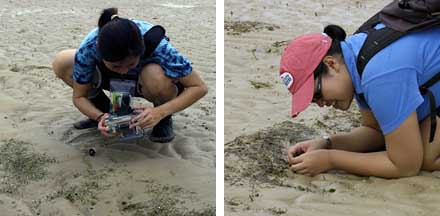
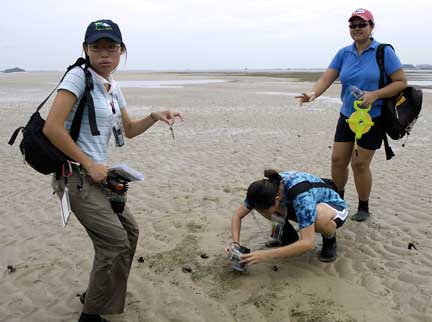
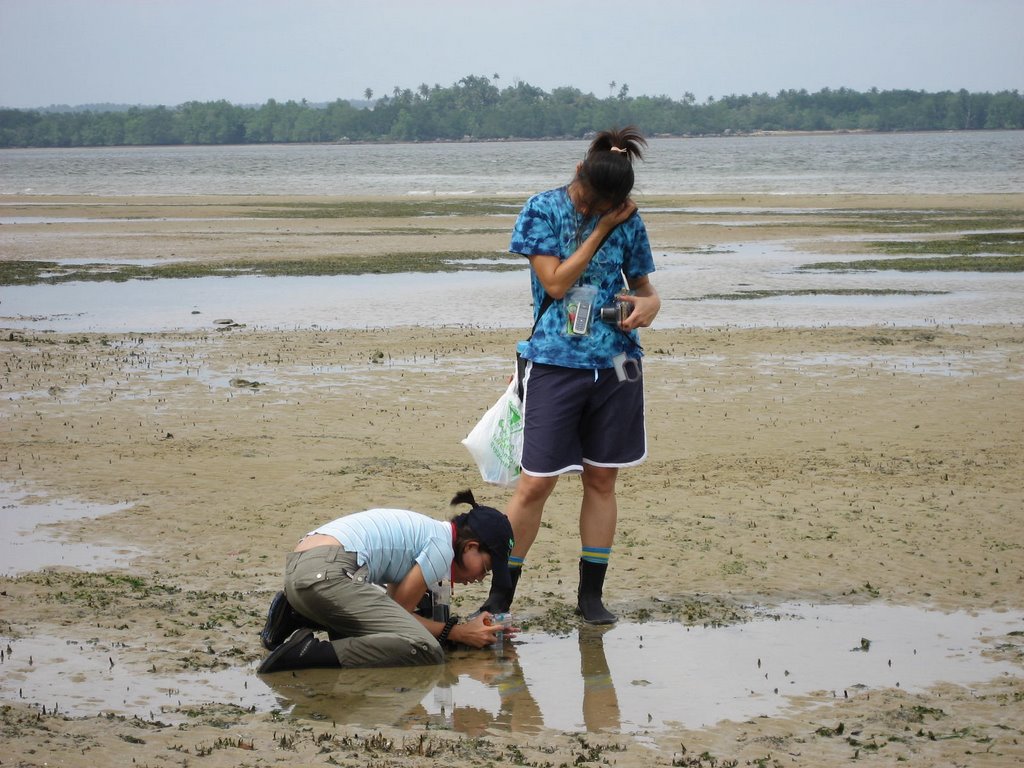
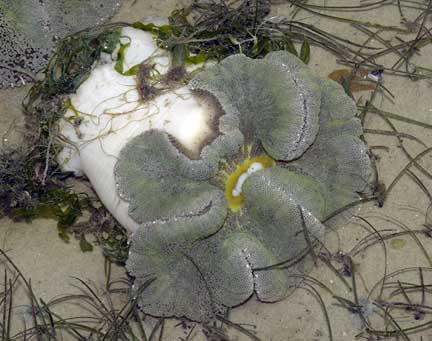
Carpet anemones and sea cucumbers appear to be the main casualties.Despite the sombre scene and smell of death everywhere, TeamSeagrass carried on with our mission. Siti explains with living examples of seagrasses while Wei Ling and Robin set up the lines.The first site is up and monitoring in progress! 50m by 50m seems huge. But it is dwarfed by Chek Jawa!A long walk to the northern sand bar and the second site is set up. I am deeply impressed by the enthusiasm and dedication of all the volunteers!While everyone is busy, I take a closer look at the casualties.

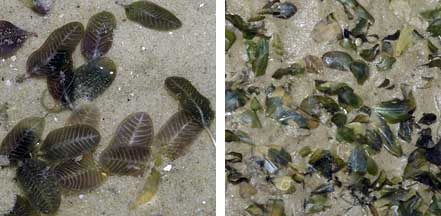
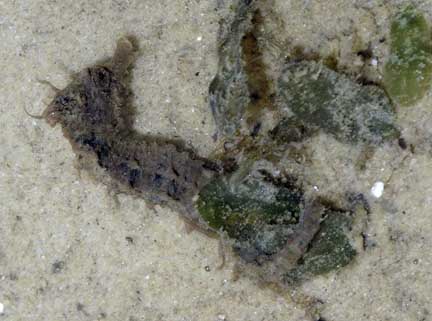
The carpet anemones seem to be bloating up and then exploding. Those that are still intact have distorted tentacles. Many were in 'pieces', and often I came across only 'melted' remains. It was heartbreaking to see so many of these magnificent creatures in distress, death and decay.Sea cucumbers were among the many casualties. Ball sea cucumbers (Phyllophorus sp.) seemed to 'deflate' like bad ping pong balls. A similar fate suffered by what seemed to have been Sandfish sea cucumbers (Holothuria scabra). There were hundreds of these poor animals in various states of distress and death.I failed to find any living sea stars (Archaster typicus), and only saw two badly decomposed ones. The noble volutes (Cymbiola nobilis) also seem to be distressed, and many clean empty shells were seen, without hermit crabs. There were also many empty gong-gong snail shells (Strombus canius).The cause of death?

Possibly the huge influx of freshwater from the Johor River due to the recent massive flooding there, following the highest recorded rainfall in 100 years. Chek Jawa lies just at the mouth of the Johor River. Locally, Singapore has also experienced record rainfall. All that freshwater probably affected the osmotic pressure of these marine animals. We're trying to find out more about this.

Apparently, there is mass death on Beting Bronok as well, a fabulous underwater reef off Pulau Tekong. We have yet to check on Changi and Pulau Sekudu which are nearby (once again, I lament that there are not enough of us to cover the shores during the few days of low tide).

Adelle shared that the Ubin villagers say this sort of thing has happened before in the past. And Chek Jawa eventually recovers. So there's some hope yet.

Although this development is very sad, it is perhaps timely as TeamSeagrass launches its first field trip. It highlights the urgency of monitoring our shores in the face of climate change. In fact, during last week's Indoor Session, one team member specifically asked about the impact of global warming on our seagrasses and shores. Sadly, one of the results is right before us.

Siti will be checking with Seagrass Watch counterparts in Johor to see whether they have similar events there and with Seagrass Watch HQ on events in the region. Again, this shows how regional efforts help better understand our shores.
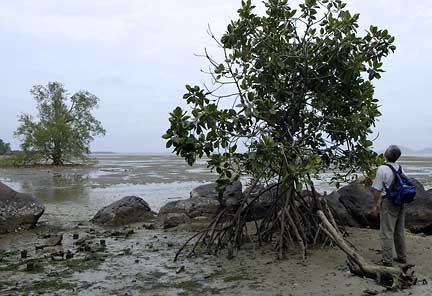
On the way to our monitoring sites, the upper shore was thickly covered with dead leaves of the Ribbon seagrass (Cymodocea rotundata). I have never seen anything like this before. The other seagrasses, however, seemed to be doing alright. Although disturbingly, we didn't manage to see any Fern seagrasses (Halophila spinolusa).

Not everything is dying. Peacock anemones (Order Ceriantharia) were still seen in what appears to be good health. The sand dollars also seemed to have survived.A more cheerful find was a little fish, a wrasse. There was also a large patch of living green mussels (Perna viridis) in the middle of the sand bar. Although this is probably a sign of a change in conditions as these mussels are not usually seen in the sand bar.Siti and Wei Ling have an even more heartening sighting.Dugong feeding trails!! ...well, perhaps.
Siti will check with Seagrass Watch HQ to confirm.

[Siti checked with Len McKenzie of Seagrass Watch HQ who replied "It definitely looks like a dugong feeding trail in the pic. Typical in width, length and path." Wow! Isn't that fabulous?!]

Amidst the deaths, Chek Jawa still has a smiley dugong feeding trail!Indeed, we wish our favourite shore a speedy recovery.

[PS. See also the Straits Times article about the mass deaths at Chek Jawa:
No more Chek Jawa tours - for now
Boon Chan Straits Times 25 Mar 07]

Jan 14, 2007

1st Seagrass Indoor Orientation kicks off!

The very 1st TeamSeagrass indoor orientation kicked off today with many people, great talks, yummy snacks and drinks!

To thank Ria, Siti and Weiling for arranging today's orientation, I volunteered to post today's entry.
But alas! What terrible photos I ha
ve - you will kill me as you scroll down to see those ugly photos with bits and pieces of you captured but HOLD YOUR GUNs - I promise to improve, ok?

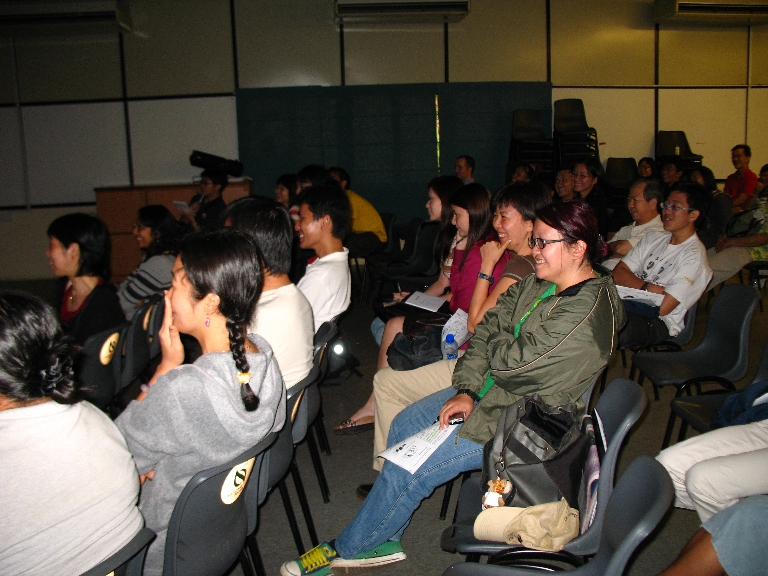
Everyone listened intently as Ria gave an introduction of our shores and what you can find there. There are some faces that those who attended today's session might remember - spot Chee Kong, the guy who saw the dolphins.

Nex
t, Siti took over and gave us lots of juicy green details on seagrass biology and of SeagrassWatch. Of course, she also took pains to drive home the important message that "algae are not seagrasses!" - those joining us on coming Friday session - keep your ears tuned and eyes opened for differences that she will be pointing out!

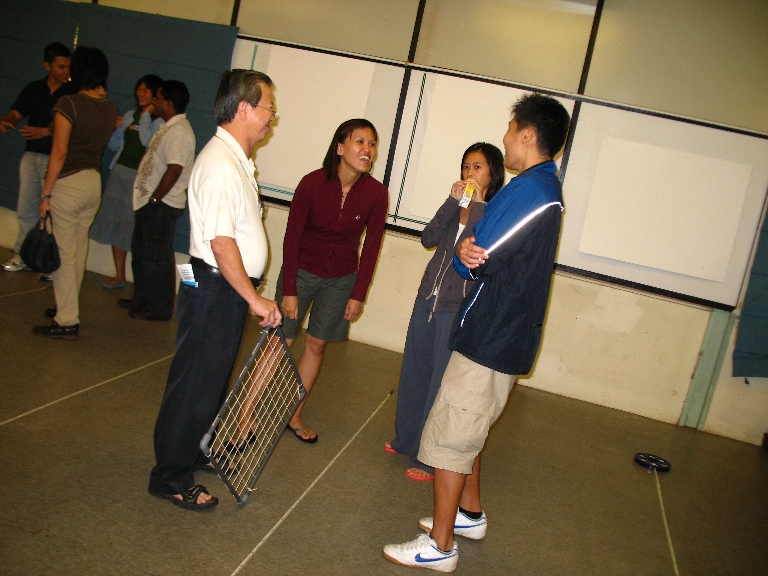
The fun part began when volunteers got into action and form groups to do 'dry runs'.

Siti gave us a briefing and demonstration on what to do...
Weiling also chipped in (with a serious look - we mean real seagrass business!) to get the ball rolling...Then, a group sprang into serious 'Action'......

another group dipped in serious 'Discussion'...

and another group indulged in serious 'Bonding' fun! =)
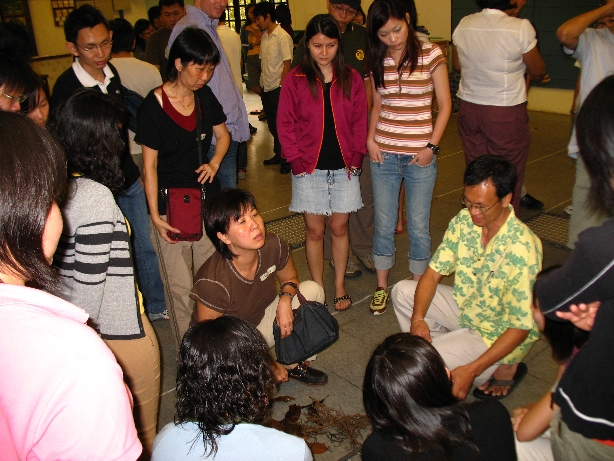
Then, I spotted a
crowd-puller! That's Dr Shawn Lum, who got some 'specimens' and helped explained the seagrass monitoring methods.

Finally, Ria wrapped up the day with safety - both the living organisms on the shore and Us-the Seagrassers. Somehow, everyone got so tickled by her recounts and lively ways, we were laughing so hard from the start till the end. A great way to finish up.. but do keep in mind her important points!


Many thanks to all who turned up for the indoor orientation - you guys made this session a success.
See you Seagrassers soon!

Jan 2, 2007

A frolicking great start to 2007

Hello Seagrassers (Seagrassers = contracted form of Seagrass-Watchers)! I hope everyone had a great festive season and start to the new year. If you're anything like me, you'd be sporting a few extra pounds and a rotund belly after all the festive feasting!

Team Seagrass spent the new year with the green and grassy denizens of Chek Jawa. We were joined by Chay Hoon of WildFilms and Joe Lai who did a survey of coastal plants of CJ.


It wasn't just a fun trip though, we were Seagrassers with a mission, and that was to do a bit of Halophila beccarii spotting and to plot the areas suitable for Seagrass-Watch transects.

Halophila beccarii has a relatively restricted distribution worldwide and is probably the hardest to come by on Singapore's shores. Currently, this species has only been recorded at CJ, where its distribution is now restricted to northern part of CJ in isolated patches on highly exposed sandy areas, where no other seagrass species find palatable.

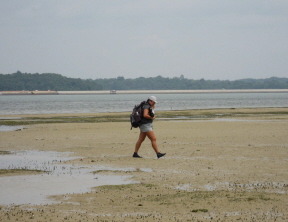
And so we trekked across the flats of CJ, with a single-mindedness rarely seen (if ever) on previous recce trips. The reward was sweet and the weary pilgrims rejoiced by going down on all fours to meet these enigmatic little plants (and they were very little).


we then went on to do more important things

ok, Wei Ling was doing important things. Shufen and I decided that the time was nigh for a bout of "seagrass dance of joy". Don't worry, you'll all get to learn it during the orientation sessions!

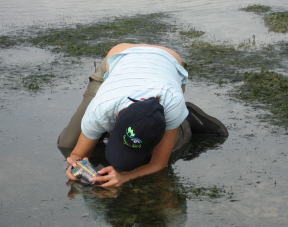
For reasons we have yet to understand, most of us were gripped by the urge to get down on all fours and close to the ground. Especially Shufen...

Here she is examining Wei Ling's foot (there was good reason for this, ask Wei Ling the next time you see her)

And here she is being enamoured by a lovely little seahorse

and again...

while Chay Hoon and Wei Ling look on


Team Seagrass also found these freaky-looking (freaky being a widely used scientific term ;)) seagrasses

The H. ovalis on the left have an unusual brown pigmentation, a case of seagrass sunburn perhaps? The picture on the left shows seagrasses with what look like bleached blonde tips.

The rest of the seagrasses look relatively healthy and seem to be making a good comeback after the algal blooms over the September - November months.
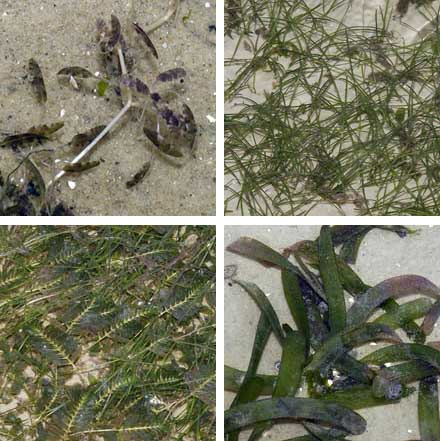
Clockwise from top left: Halophila beccarii, Halodule sp., Halophila spinulosa and Thalassia hemprichii.

But other orgnisms didn't seem to chuffed, like the carpet anemones, which we think have been affected by the amount of freshwater input from the recent heavy rains.


And as always, the non-seagrass inhabitants of CJ never fail to enthrall us, from this tiny seahorse


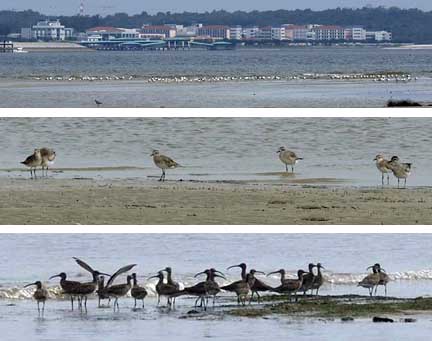
to the numerous shore birds feeding at the waters edge


We even spotted a Great Billed Heron feeding


And the clincher, a photo of Ria (albeit from a distance).

This one is shot in stealth mode and from a distance. Pictures of Ria are pretty hard to come by because she's usually the one taking the photos :)

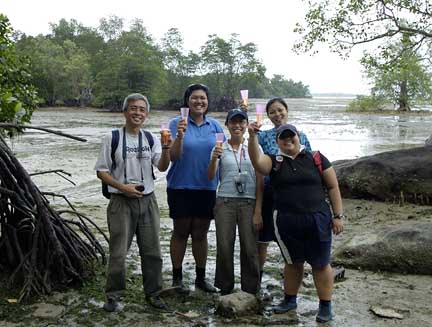
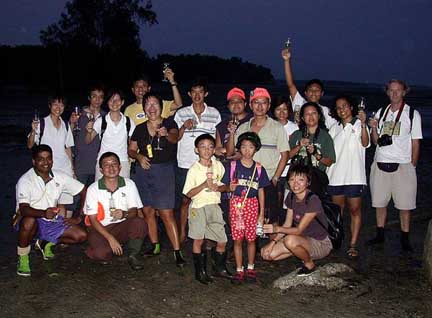
In keeping with tradition on its hallowed ground, we made a New Years' Day toast to Chek Jawa- may there be many more years of untouched glory - and to Team Seagrass :)


The first New Years' Day toast to CJ, just after deferment was announced.

Dec 13, 2006

Indoor Orientation: 13 Jan 07 (Sat) 2-5pm and 19 Jan 07 (Fri) 7.30-10pm

To kick start Seagrass Watch and TeamSeagrass, we are planning Indoor Orientation followed by Field Orientation sessions in January.

Indoor Orientation
13 Jan 07 (Sat) 2pm-5pm
19 Jan 07 (Fri) 7.30pm –10pm

Field Orientation
20 Jan (Sat): Chek Jawa depart Changi Village jetty 1600hrs end 2000hrs
21 Jan (Sun): Pulau Sekudu depart Changi Village jetty 1730hrs end 2030hrs
More on how to get there on Watch Locations

Only those who have attended the Indoor Orientation will be allowed to attend the Field Orientation. This is for your safety. You will only need to attend one Indoor Session.

We hope to get ready for Real Watch sessions when the super low tides start in Mar 07!

Here's what happened at the last Indoor Orientation session for the Sentosa transect

Indoor Orientation Programme
13 Jan 07 (Sat)/19 Jan 07 (Fri)

2pm/7.30pm: We got seagrass meh? by Ria
Introduction to the shores we're going to monitor and other surprising things about your shores

2.15pm/7.45pm: Seagrass Science by Siti
Introduction to seagrasses, identification, recording techniques

3.15pm/8.45pm: Break

3.30pm/9pm: Seagrass Samba by everyone
Practice setting up, try out the monitoring methods and taking photos. Usually results in a quite a dance-about as we figure things out :-)

4.45pm/9.45pm: Seagrass Safety by Ria
Safety and logistics: getting there and back in one piece--both you and the seagrasses.

5pm/10pm: End

Venue: NParks Peirce Road Multi-Purpose Hall, Peirce Road Depot
Peirce Road off Holland Road
(near the place where they sell durians in the carpark)These is free parking at the depot, pls park in an orderly manner.

Getting there by public transport
1) From Orchard MRT Station, go to the bus stop at Orchard Boulevard
2) Buses to take: 77, 174, 106, 123, 7
3) Get off at the third bus stop AFTER the Gleneagles Hospital/Botanic Gardens bus stop
4) From the bus stop walk towards the traffic light and you will see the signboard at Peirce Road that says National Parks Board. The entrance to the Depot is about 200m down Peirce Road on your left.

Please BE PUNCTUAL so we can start on time and end on time. Punctuality is critical in all TeamSeagrass activities as they are tide dependent. And time and tide waits for no one :-)

Bring a note-book to take notes during the session.

Sign up for TeamSeagrass
Email
(a) your full name
(b) your age
(c) your email address
(d) your contact number
(e) any previous experience in field work, outdoor nature activities, volunteering in nature work, with which groups? (it's OK if you don't have any)
(f) Which Indoor Orientation session will you attend?
(g) Which Field Orientation sessions will you attend?

to Ria at hello@wildsingapore.com
(pls put "teamseagrass" in the subject line, this email gets a lot of spam)

Please read the FAQs on TeamSeagrass before emailing me questions.

New seagrass growing techniques

We should appreciate our seagrasses! Don't wait until they are wiped out!

University of Delaware 11 Dec 06
New eelgrass growing techniques would help bays
Article by Tracey Bryant
full article on wildsingapore wildnews

Extracts ...

Before disease decimated it years ago, eelgrass thrived around the globe in estuaries like Delaware's Inland Bays.

The sea-dwelling plant provides food and habitat for crabs, fish and waterfowl. It improves water quality by removing excess nutrients from the water and stabilizes the bay bottom as its long, ribbon-like leaves trap floating particles of sediment.

Environmental managers would like to get their hands on more eelgrass for bay restoration projects. But it's not as easy as going out and buying a bag of grass seed or a flat of plants at your local garden center. At least not yet.

“Eelgrass is a cold-water plant that was once widely distributed,” Gallagher said. “Then in the 1930s, there was a worldwide die-off of the plant due to wasting disease”.

This disease is thought to be caused by a slime mold that attacks the plant's leaves. The loss of the once-prolific eelgrass set off a chain reaction of serious impacts, including the starvation of large numbers of brant, a species of waterfowl that relies on the plant as a primary food source.

While eelgrass populations have rebounded in some locations over the years, restoration efforts have been essential to the plant's recovery elsewhere, particularly in areas that have undergone significant environmental degradation due to increased nutrient inputs, erosion and other stresses, Gallagher said.

However, the restoration process often is slow due to the scarcity of plant material. Currently, environmental managers must harvest seeds from eelgrass growing in the wild or dig up plants from healthy beds for transplant to new beds.

Currently, the UD research team is working on two methods for propagating eelgrass.

Dec 1, 2006

Seagrass-Watch Newsletter is out!

The Nov/Dec 2006 issue of the Seagrass-Watch Newsletter is in print and can be found on the Seagrass-Watch website.

Download the pdf to read the articles about TeamSeagrass and Chek Jawa and other seagrass news.

Here's some excepts about TeamSeagrass...and how TeamSeagrass got started...... and more seagrass adventures ahead!There's also an interesting article about seagrasses and sunburn in this issue.